
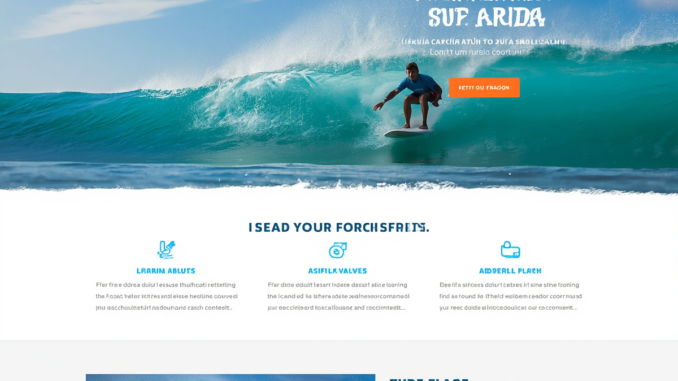
Choosing the right Surf camp website design Costa Rica approach requires more than beautiful photographs of waves and tropical beaches. Instead, the website should help travelers understand the experience, trust the camp, compare packages, check availability, and move naturally toward booking.
That becomes especially important in Costa Rica. A potential guest may compare surf camps in Tamarindo, Nosara, Santa Teresa, Jacó, and other destinations before making a decision.
Some travelers research months before their trip. Meanwhile, others look for surf lessons or retreats after they have already arrived in the country.
Therefore, the website needs to work for both situations.
A successful surf camp website combines visual storytelling, useful information, mobile usability, booking technology, SEO, and clear calls to action.
The goal is not simply to make surfing look exciting.
Instead, the website should answer the questions travelers ask before committing several days of their vacation to one experience.
Where will they stay?
How many surf sessions are included?
Is the camp suitable for beginners?
What does the package cost?
Are boards included?
How do they reserve?
A strong website answers those questions before uncertainty becomes a reason to leave.
1. Why Website Design Matters for Surf Camps in Costa Rica
Costa Rica offers a distinctive environment for surf tourism.
The country combines well-known surf towns, tropical landscapes, accommodation, coaching, adventure activities, and an established international travel market.
Consequently, surf camps are not competing only on access to waves.
They are also competing on experience.
A guest may compare coaching style, accommodation, group size, location, meals, transportation, atmosphere, and price.
Therefore, the website needs to communicate the complete offer.
Create a Strong First Impression
Surfing is highly visual.
Fortunately, surf camps have access to compelling material.
Ocean photography, instructors, accommodation, social spaces, meals, sunsets, and real guest experiences can all help communicate the atmosphere.
However, visuals need context.
A dramatic photograph of a surfer does not tell a beginner whether they are welcome.
Likewise, a beautiful aerial view does not explain what a seven-night retreat includes.
Therefore, the first screen should combine emotion with clarity.
A useful opening section might immediately communicate:
- Location
- Type of surf experience
- Skill level
- Primary differentiator
- Main booking action
For example, a beginner-focused retreat could emphasize supportive coaching and small groups.
Meanwhile, an advanced surf camp might lead with video analysis, technical coaching, and specific surf conditions.
Build Trust Before Asking for a Booking
Most surf camp bookings involve meaningful travel decisions.
A guest may need flights, transportation, accommodation, time away from work, and a substantial financial commitment.
Therefore, trust becomes essential.
Useful trust signals can include:
- Real guest reviews
- Authentic photography
- Instructor profiles
- Clear prices
- Cancellation terms
- Secure payment information
- Contact details
- Location information
- FAQs
- Booking confirmation details
Avoid artificial urgency.
Likewise, avoid testimonials that cannot be verified.
Credibility usually converts better over time than aggressive sales tactics.
Turn Interest Into Enquiries and Bookings
Traffic alone is not enough.
Instead, every important page should give the visitor a logical next step.
For example, someone reading about a beginner retreat could move directly to available packages.
A visitor exploring accommodation should be able to reach room options or dates.
Useful calls to action include:
- Check Availability
- Explore Packages
- View Retreat Dates
- Book Your Surf Camp
- Plan Your Surf Trip
These actions are more specific than a generic “Learn More” button.
Consequently, visitors understand what will happen after they click.
2. Essential Features of a Surf Camp Website
A surf camp website needs more than a homepage and contact form.
Instead, its architecture should follow the questions travelers ask before booking.
A useful structure might include:
- Homepage
- Surf packages
- Individual retreat pages
- Surf lessons
- Accommodation
- Instructors
- Location
- Reviews
- FAQs
- About
- Contact
- Availability
- Booking
- Terms and cancellation policies
However, not every camp needs every page.
The final architecture should follow the actual business.
Clear Surf Packages
Unclear packages create friction.
Therefore, each package should explain exactly what the guest receives.
Useful information may include:
- Number of nights
- Number of lessons
- Coaching format
- Surf level
- Group size
- Board rental
- Accommodation type
- Meals
- Transportation
- Airport transfers
- Photography or video analysis
- Additional activities
- Dates
- Price
- Deposit
- Cancellation terms
If pricing changes according to season or room type, explain that clearly.
Likewise, if “all-inclusive” does not include every meal or activity, define the term.
Transparent packages make comparison easier.
Dedicated Pages for Important Retreats
Important offers should usually have their own URLs.
For example, a camp might offer:
- Beginner surf week
- Intermediate coaching retreat
- Advanced surf coaching
- Private surf camp
- Women’s surf retreat
- Family surf package
Giving these experiences separate pages allows the camp to explain each one properly.
Additionally, each page can target a more specific search intent.
That is generally more useful than placing every package inside one enormous page.
Authentic Surf Photography
Stock imagery can weaken trust.
Instead, show the actual experience whenever possible.
Useful photographs may include:
- Real surf sessions
- Instructors coaching guests
- Accommodation
- Bedrooms
- Social areas
- Meals
- Equipment
- Beach access
- Transportation
- Nearby surroundings
However, image quality should not destroy performance.
Compress large files and use appropriate dimensions.
As a result, the website can remain visually impressive without becoming painfully slow.
Reviews and Guest Stories
Reviews are particularly useful when travelers are comparing similar camps.
Place relevant testimonials close to decision points.
For example, a beginner package can show feedback from previous beginner surfers.
Meanwhile, an advanced program can highlight comments related to coaching quality.
This creates stronger context than putting every testimonial on one isolated page.
3. Mobile-First Design for Surf Travelers
Mobile design deserves special attention.
A traveler may browse from home months before a trip.
However, another visitor may be sitting in a hostel in Santa Teresa looking for surf lessons tomorrow.
Both visitors may use phones.
Therefore, mobile usability needs to work from the beginning.
Keep Important Information Near the Top
A mobile visitor should quickly understand:
- What the camp offers
- Where it is located
- Who it is for
- What the next step is
Do not force users through a large autoplay video before showing useful information.
Instead, combine a strong visual with concise messaging.
Then provide a clear call to action.
Make Buttons Easy to Use
Booking buttons should be easy to tap.
Likewise, forms should not contain unnecessary fields.
Calendars, dropdown menus, WhatsApp links, and payment interfaces should all work comfortably on smaller screens.
If users need to zoom or fight with the interface, friction increases quickly.
Balance Photography With Performance
Large surf images are valuable.
However, oversized media can make mobile pages slow.
Therefore, optimize:
- Image dimensions
- Compression
- Video usage
- Third-party scripts
- Fonts
- Tracking tools
- Booking widgets
Google PageSpeed Insights can identify technical problems.
Nevertheless, the real visitor experience matters more than chasing a perfect numerical score.
4. Surf Camp Website Inspiration From Costa Rica
Studying real websites can reveal useful patterns.
However, the goal should not be copying layouts.
Instead, identify why certain decisions work.
Surf Simply: Clear Premium Positioning
Surf Simply offers a useful example from Nosara.
The brand positions itself around technical surf coaching rather than conventional beginner lessons.
That distinction appears immediately.
Its website combines the resort experience with coaching philosophy, educational content, accommodation information, pricing, availability, and supporting resources.
Additionally, the site makes its positioning clear through messaging rather than relying only on elegant design.
Design lesson: explain why the camp is different.
Premium design works best when the service itself has clear differentiation.
Tortuga Surf Camp: Detailed Retreat Information
Tortuga Surf Camp provides another useful reference.
Its retreat content explains personalized surf training around Jacó and the Central Pacific.
Additionally, the page provides practical information about coaching, accommodation, airport transfers, equipment, activities, and the skills guests can expect to develop.
This depth helps visitors evaluate the experience.
Design lesson: a surf retreat page should explain both emotional benefits and practical details.
Dribbble: Useful for Visual Inspiration
Dribbble’s surf camp search can help explore visual directions.
For example, designers can review:
- Typography
- Color systems
- Illustration
- Hero layouts
- Branding
- Card layouts
- Surf-inspired graphics
However, Dribbble primarily shows design concepts.
A beautiful concept does not automatically demonstrate good mobile usability, SEO, accessibility, or booking performance.
Therefore, treat visual inspiration as a starting point.
Functionality still needs independent evaluation.
5. DIY Website vs. Booking Platform vs. Professional Designer
A Surf camp website design Costa Rica project can be approached in several ways. Therefore, the right solution depends on the size of the camp, booking process, budget, and level of customization required.
The three common approaches are a DIY website builder, a specialized booking platform, or a professionally designed website.
| Option | Best For | Main Advantages | Main Limitations | Booking Setup | SEO Flexibility |
|---|---|---|---|---|---|
| DIY website builder | Small surf schools and simple camps | Lower initial cost, quick setup, direct editing | More manual configuration and limited custom UX | Form, plugin, widget, or external engine | Usually good, depending on platform |
| Specialized booking platform | Camps with fixed dates, capacity, packages, and frequent reservations | Availability, payments, automation, booking management | Less design freedom and platform dependency | Native booking tools | Moderate to good |
| Professional web designer | Premium retreats, established camps, custom brands, complex integrations | Custom UX, stronger branding, tailored SEO, integration planning | Higher initial investment | Integrated booking engine or custom workflow | Potentially very strong |
When a DIY Website Makes Sense
A small surf school may not need a large custom project.
For instance, the business might only require:
- Homepage
- Lessons
- Packages
- About
- Contact
- Simple booking widget
In this situation, WordPress, Squarespace, Webflow, or another suitable builder may work well.
However, calculate the complete cost.
Premium themes, plugins, booking systems, hosting, and maintenance can increase the real investment.
If WordPress is under consideration, this guide to WordPress designers in Costa Rica provides additional guidance on choosing a professional and planning the platform.
When a Specialized Booking Platform Makes Sense
A retreat with fixed arrivals and limited capacity may benefit from specialized software.
For example, the system may manage:
- Dates
- Remaining spots
- Deposits
- Room types
- Guest information
- Payments
- Confirmations
- Cancellation rules
Consequently, staff can spend less time managing spreadsheets or email threads.
However, assess the public-facing experience too.
A strong operational system can still provide a weak marketing website.
When a Professional Designer Makes Sense
A professional designer becomes especially useful when the website is expected to support a premium or differentiated brand.
For example, the project may require:
- Custom visual identity
- Advanced booking integration
- Multilingual pages
- Destination SEO
- Custom retreat pages
- Professional UX
- Analytics
- Conversion tracking
- Content architecture
In many cases, the designer does not replace booking software.
Instead, the designer connects specialized operational technology with a stronger customer-facing website.
6. Designing a Surf Camp Booking Experience
A beautiful website can still lose bookings when the reservation process is confusing.
Therefore, map the booking journey before designing decorative details.
A straightforward process might look like this:
Choose retreat → Select dates → Select room → Add guests → Review package → Pay deposit → Receive confirmation
However, not every business needs instant booking.
Fixed-Date Retreats
Fixed retreats can work well with live availability.
For example, visitors can select from published dates and see remaining capacity.
Then, they can choose room types or package upgrades.
This approach works best when inventory stays accurate.
Personalized Surf Experiences
Private coaching and customized programs may require an enquiry process instead.
In that case, the form could request:
- Preferred dates
- Number of guests
- Surf level
- Accommodation requirements
- Main goals
- Contact information
Do not request excessive information too early.
Instead, collect what the team needs to provide the next useful response.
Make Pricing Easy to Understand
Unexpected costs damage trust.
Therefore, explain:
- Package price
- Taxes
- Deposit
- Remaining balance
- Included services
- Optional extras
- Cancellation rules
If prices vary, explain why.
Transparency makes booking decisions easier.
Confirm What Happens Next
Once a guest pays or submits an enquiry, explain the next step.
A useful confirmation might include:
- Dates
- Package
- Number of guests
- Amount paid
- Balance
- Arrival instructions
- Contact details
- Packing guidance
- Cancellation conditions
Consequently, customers feel confident that the reservation was received correctly.
7. WhatsApp, Forms, and Booking Integrations
Costa Rican tourism businesses often use WhatsApp.
It can be extremely convenient.
However, WhatsApp should support the booking journey rather than replace every structured process.
Use One Primary Action
Too many competing buttons can confuse visitors.
For example, a retreat page might feature:
Check Dates & Availability
Then, a secondary action could say:
Questions? Ask Us on WhatsApp
This hierarchy keeps booking as the main action.
Use Forms for Structured Enquiries
Contact forms work particularly well when the camp needs several details.
For example, a form can capture:
- Dates
- Surf level
- Group size
- Accommodation
- Special requirements
As a result, staff receive more useful enquiries.
Integrate Booking Technology Carefully
External booking systems should feel connected to the website.
Poor integrations can create:
- Different branding
- Confusing navigation
- Unexpected redirects
- Difficult mobile interfaces
- Duplicate information
- Unclear payment steps
Therefore, test the entire process as a customer.
8. SEO for Surf Camps in Costa Rica
Surf camps compete for highly location-sensitive searches.
Therefore, SEO should connect services with real destinations.
Useful themes can include:
- Surf camp Costa Rica
- Beginner surf camp
- Surf retreat Costa Rica
- Surf coaching
- Surf lessons
- Surf accommodation
- Surf packages
- Local destination terms
However, avoid creating dozens of nearly identical pages.
Useful content matters more than volume.
Build Strong Package Pages
Important packages should contain detailed information.
For example:
- Surf level
- Duration
- Dates
- Coaching
- Accommodation
- Price
- Inclusions
- FAQs
- Booking information
This creates a stronger commercial page.
Additionally, it gives search engines clearer context.
Create Useful Destination Content
A camp in Nosara can create useful content about Nosara.
Likewise, a business in Santa Teresa can answer questions specific to that location.
Useful topics may include:
- How to get there
- Surf seasons
- Nearby beaches
- Transportation
- Restaurants
- Local activities
- What to pack
However, only create destination pages where the camp has a genuine connection.
Publish Content for Earlier Research Stages
Not every traveler is ready to book.
Some are still planning.
Therefore, useful articles might answer:
- What should beginners bring to surf camp?
- When is the best time to surf in Costa Rica?
- How does a surf retreat work?
- Which surf level should I choose?
- What happens during a week of coaching?
These topics can introduce the camp earlier in the travel-planning process.
Connect Related Tourism Content Naturally
Surf camps often overlap with accommodation, tours, and hospitality.
Therefore, related resources can be useful when they genuinely help the reader.
For example, businesses expanding into guided activities may benefit from this guide to tour operator website design in Costa Rica.
Meanwhile, camps that also operate villas or independent lodging can explore this guide to vacation rental website builders in Costa Rica.
Businesses positioning themselves as boutique hospitality experiences may also find useful ideas in boutique hotel web design in Costa Rica.
The goal is to help visitors continue researching relevant topics.
9. Bilingual Surf Camp Websites
A Surf camp website design Costa Rica project may need to serve international travelers and Spanish-speaking customers at the same time. Consequently, multilingual planning should happen early.
Adding another language is not simply a translation task.
Navigation, SEO, booking information, and maintenance also need consideration.
Keep Important Information Consistent
Critical information should match across active language versions.
That includes:
- Packages
- Prices
- Dates
- Policies
- Accommodation
- Booking instructions
- Safety information
- FAQs
If one version changes, the other should be reviewed.
Otherwise, guests can receive conflicting information.
Optimize for Different Search Behavior
English and Spanish users do not necessarily search with literal translations of the same phrase.
Therefore, keyword research should consider each audience separately.
This also allows headings and metadata to sound natural in each language.
Clarify Currency and Travel Information
International visitors may need extra context.
For example:
- Which currency is displayed?
- Where does airport transportation begin?
- Which airport is closest?
- Is WhatsApp available?
- When is the final balance due?
- How long does ground transportation take?
Answering these questions reduces uncertainty.
10. How to Hire a Web Designer in Costa Rica
When hiring someone for a Surf camp website design Costa Rica project, evaluate more than visual style. The designer should understand how branding, booking technology, mobile UX, content, and SEO work together.
For a broader checklist, see this guide to hiring web designers in Costa Rica.
Review Relevant Portfolio Work
Open real websites rather than relying only on screenshots.
Then, evaluate:
- Mobile usability
- Photography
- Page speed
- Navigation
- Booking actions
- Forms
- Typography
- Content structure
Hospitality, tourism, retreats, hotels, and travel projects are particularly relevant.
However, exact surf-camp experience is not mandatory.
Strong booking UX can transfer between industries.
Ask About Booking Integrations
Explain how reservations currently work.
For example:
- Do guests book fixed dates?
- Is room inventory limited?
- Do you collect deposits?
- Is WhatsApp involved?
- Do you use existing booking software?
- Can guests select room types?
Then ask the designer how the website will support that process.
Evaluate SEO Knowledge
A surf camp website may eventually contain packages, destinations, articles, accommodation pages, and retreat dates.
Therefore, information architecture matters.
Ask how these pages will be organized.
Additionally, confirm that you can edit content later.
Ask About Image Optimization
Surf websites are media-heavy.
Therefore, the designer should have a strategy for photography and video.
Ask how files will be optimized for phones and slower connections.
Define Ownership
Before paying, confirm who controls:
- Domain
- Hosting
- CMS
- Booking account
- Analytics
- Website files
- Plugins
- Forms
- Email integrations
Important business accounts should remain accessible to the owner.
Prepare a Clear Brief
Include:
- Camp location
- Packages
- Skill levels
- Accommodation
- Booking process
- Dates
- Languages
- Payment requirements
- Existing booking system
- Photography
- Brand materials
- SEO goals
A detailed brief makes proposals easier to compare.
11. Recommended Web Designers and Web Professionals in Costa Rica
The following four Costa Rica-based profiles can be included in your initial evaluation.
They are not interchangeable.
Therefore, review current portfolios and discuss the specific surf-camp requirements before choosing anyone.
1. Josue Baldizon
Josue Baldizon is a Costa Rica-based web designer whose public portfolio includes WordPress, eCommerce, service businesses, and a travel website built around Costa Rica packages and booking flows.
That travel-related work makes the profile especially relevant to evaluate for tourism and hospitality projects.
Consider this profile if: you want to evaluate a professional for WordPress development, UX, branding, booking-oriented layouts, and conversion-focused web design.
2. Alejandro L.
This Costa Rica-based profile is worth reviewing when visual execution and multimedia are important parts of the project.
Surf camps depend heavily on strong visual presentation.
Therefore, creative design capabilities can be valuable.
However, confirm WordPress, booking integration, SEO, and development requirements directly before hiring.
Consider this profile if: the visual identity and multimedia presentation of the camp are major priorities.
3. Felipe F.
This Costa Rica-based profile is worth evaluating when the website has an important technical component.
For example, a surf camp may need custom integrations, booking functionality, or troubleshooting between several platforms.
Before starting, confirm experience with your selected CMS and reservation software.
Consider this profile if: programming and technical integration are important parts of the project.
4. Xenia B. B. C.
View Xenia B. B. C. on Workana.
This Costa Rica-based profile can also be reviewed when design and multimedia support form part of the project.
However, clarify technical responsibilities early.
For example, determine who will handle development, booking integration, SEO, and website maintenance.
Consider this profile if: you need visual design support and the current portfolio fits the camp’s desired identity.
How to Compare the Four Options
Send suitable professionals the same brief.
Then compare:
- Recommended platform
- Booking solution
- Mobile approach
- Design process
- SEO architecture
- Multilingual setup
- Photography optimization
- Revision process
- Timeline
- Ownership
- Maintenance
- Support
Additionally, ask for relevant live examples.
Price matters.
However, project fit matters more.
12. The Surf Camp Website Design Process
A successful website begins before visual design.
Therefore, start with business and customer requirements.
Discovery and Strategy
Document:
- Main guest profiles
- Surf levels
- Packages
- Accommodation
- Dates
- Booking rules
- Payment rules
- Locations
- Languages
- Main competitors
- Existing technology
These answers shape the website.
Sitemap and Content Planning
Next, define the page hierarchy.
For example:
Home → Packages → Individual Retreat → Accommodation → Instructors → Location → FAQs → Booking
A more complex camp may also need destination or activity content.
Planning this structure early reduces duplication.
Design
The visual system should reflect the camp’s positioning.
A premium technical coaching retreat may look different from a social backpacker surf camp.
Useful design components can include:
- Surf photography
- Tropical color system
- Clear typography
- Package cards
- Review blocks
- Instructor profiles
- Booking buttons
- Room galleries
However, decoration should never hide important information.
Development
Once layouts are approved, development can begin.
This stage may include:
- CMS
- Booking integration
- Forms
- Analytics
- Multilingual functionality
- SEO settings
- Responsive layouts
Then, real content should be tested inside the design.
Testing
Before launch, check:
- Mobile navigation
- Package pages
- Booking buttons
- Availability
- Forms
- Payments
- WhatsApp links
- Language switching
- Confirmation emails
- Speed
- SEO basics
Additionally, ask someone unfamiliar with the camp to test the website.
Fresh users often identify problems the team no longer notices.
Launch and Improvement
Publishing is only the beginning.
After launch, monitor:
- Enquiries
- Booking starts
- Completed bookings
- Mobile behavior
- Popular packages
- Organic traffic
- Contact questions
These signals can reveal where improvements are needed.
13. Common Surf Camp Website Mistakes
Surf camps often have outstanding visual assets.
Ironically, that can create some common design problems.
Too Much Video
Background video can create atmosphere.
However, several large videos can slow the website dramatically.
Use them selectively.
Beautiful but Vague Messaging
Phrases such as “Live the Pura Vida dream” can support the brand.
However, they do not replace practical information.
Pair emotional copy with package details.
Hidden Pricing
Some camps genuinely require custom quotes.
That is fine.
However, explain why.
If fixed pricing exists, making visitors message the camp simply to discover the cost creates unnecessary friction.
Outdated Dates
Retreat dates need regular maintenance.
Otherwise, visitors may question whether the website is active.
Therefore, create an easy process for updating availability.
Too Many Calls to Action
One page should not simultaneously shout:
- Book Now
- Email Us
- Request Quote
- Contact
- Learn More
Instead, establish one primary action.
Generic Stock Photography
Real guests want to see the real experience.
Therefore, authentic photography usually provides more value than generic tropical images.
Weak Mobile Design
A website may look excellent on a designer’s large monitor.
However, travelers often use phones.
Always test mobile thoroughly.
14. How Much Does a Surf Camp Website Cost?
There is no universal price.
A small surf school and a premium resort have different requirements.
Therefore, cost should follow scope.
What Affects the Price?
Important variables include:
- Number of pages
- Number of packages
- Custom design
- Booking integration
- Accommodation pages
- Languages
- SEO
- Copywriting
- Photography
- Video
- Analytics
- Custom functionality
- Maintenance
A basic website can launch with relatively simple functionality.
Meanwhile, a premium retreat may require extensive content and custom integrations.
Template vs. Custom Design
A template can be perfectly suitable for a smaller business.
It can reduce development time and initial cost.
However, custom design becomes more valuable when the brand needs stronger differentiation.
For example, a premium coaching resort may want a distinct visual and booking experience.
Neither option is automatically better.
Choose according to business needs.
Include Booking Software Costs
Reservation systems may charge:
- Monthly subscriptions
- Transaction fees
- Payment fees
- Integration fees
Therefore, evaluate the complete technology stack.
A cheap website combined with several expensive tools can become costly.
Remember Maintenance
Ongoing expenses can include:
- Hosting
- Domain renewal
- Plugins
- Booking software
- Security
- Backups
- Content updates
- Professional maintenance
Therefore, ask providers about both initial and recurring costs.
Frequently Asked Questions
What Makes a Good Surf Camp Website?
A good surf camp website combines strong visuals with clear practical information.
Visitors should understand the destination, surf level, accommodation, packages, dates, prices, and booking process.
Additionally, the site should work well on mobile devices.
Which Platform Is Best for a Surf Camp?
There is no universal answer.
WordPress can offer extensive flexibility.
Meanwhile, Webflow can support highly customized visual layouts.
Squarespace may suit simpler projects.
The correct choice depends on booking needs, budget, editing requirements, and long-term maintenance.
Should a Surf Camp Use WordPress?
WordPress can work very well for content-rich surf camp websites.
It supports packages, destination pages, blogs, multilingual content, and external booking integrations.
However, it needs proper hosting and maintenance.
Does a Surf Camp Need Online Booking?
Not necessarily.
Fixed packages and retreat dates can benefit from online booking.
Meanwhile, highly personalized programs may work better with structured enquiries.
The correct approach depends on the business model.
Should Prices Be Published?
When pricing is fixed, publishing it can reduce uncertainty.
However, some customized retreats require quotes.
In that situation, clearly explain what affects pricing.
Should a Surf Camp Website Be Bilingual?
It depends on the audience.
English is often important for international surf travelers.
Meanwhile, Spanish may support domestic guests and regional markets.
If both languages are offered, maintain important information consistently.
How Can a Surf Camp Get More Organic Traffic?
Build detailed package pages, create useful destination content, answer traveler questions, improve mobile performance, and maintain a logical website structure.
However, SEO takes time.
Avoid guaranteed ranking claims.
Should I Hire a Costa Rica-Based Designer?
A local professional can offer advantages in communication and regional context.
However, location should not be the only selection criterion.
Review relevant work, technical ability, communication, and booking experience.
What Should I Ask a Designer Before Hiring?
Ask about:
- Booking integration
- Mobile design
- SEO
- Photography
- Platform choice
- Multilingual content
- Ownership
- Hosting
- Maintenance
- Post-launch support
Additionally, request relevant live websites.
Can a Surf Camp Website Integrate WhatsApp?
Yes.
WhatsApp can work well as a secondary communication option.
However, standard reservations may benefit from a more structured booking process.
Conclusion
A successful surf camp website should capture the excitement of surfing in Costa Rica while making travel planning feel simple.
Therefore, beautiful photography should support useful information rather than replace it.
Guests need to understand the packages.
They need to know where they will stay.
They need clarity about their surf level, dates, pricing, coaching, and booking process.
Mobile usability matters because travelers frequently research on phones.
Meanwhile, SEO matters because potential guests need a way to discover the camp.
Booking technology matters because interest needs a clear next step.
Trust matters because a surf retreat is a meaningful travel purchase.
Consequently, every part of the website should support the same customer journey.
A DIY website may be enough for a small surf school.
A specialized booking platform can improve operations for fixed-date retreats.
Meanwhile, professional design can provide greater control over branding, SEO, UX, and integrations.
Ultimately, the right Surf camp website design Costa Rica strategy combines authentic storytelling, practical information, mobile usability, useful SEO content, trustworthy booking technology, and a clear path from inspiration to reservation.
Show the experience.
Explain the details.
Then make the next step easy.

Leave a Reply