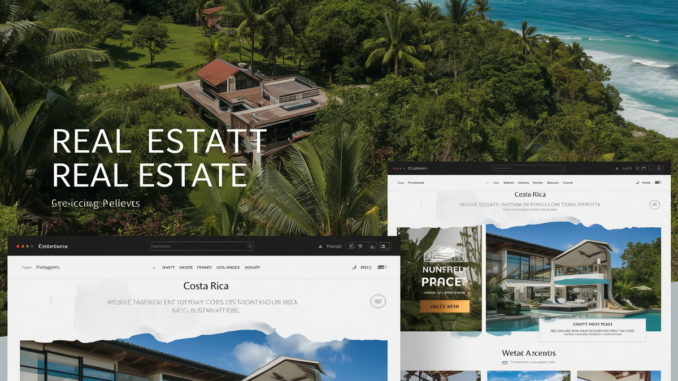
Investing in professional real estate website design costa rica allows property brokerages and developers to build high-converting sales platforms. In today’s competitive property market, a simple online catalog is no longer sufficient. Consequently, your agency requires an optimized digital infrastructure that builds immediate credibility with high-net-worth buyers.
Costa Rica represents one of the most dynamic real estate markets in Latin America. Property firms frequently serve domestic buyers, foreign retirees, relocation clients, and international real estate investors simultaneously. Therefore, your digital platform must bridge regional business practices and international consumer expectations seamlessly.
Furthermore, a well-engineered real estate website functions as your primary 24/7 sales representative. It showcases luxury listings, qualifies prospective buyer inquiries, and automates client intake workflows. As a result, partnering with a knowledgeable local developer ensures sustainable commercial growth in a demanding market.
1. The Dual-Audience Property Market: Domestic Buyers vs. International Investors
Analyzing International Expat and Investor Search Behavior
International property buyers approach real estate research with specific logistical questions. For instance, foreign investors often explore properties from thousands of miles away.
Consequently, they require detailed geographical context, legal purchasing information, and lifestyle data before scheduling viewings. Providing comprehensive community guides helps eliminate buyer hesitation. Therefore, informative digital content accelerates the property sales cycle significantly.
| Buyer Category | Core Motivation | Primary Website Feature Needed |
| Foreign Investors | Capital appreciation & rental yields | Detailed ROI calculators & neighborhood data |
| Relocating Expats | Lifestyle, climate & healthcare access | Bilingual community guides & school proximity |
| Domestic Buyers | Urban convenience & local financing | Colones pricing & direct bank loan tools |
Catering to Domestic Costa Rican Property Buyers
Domestic buyers navigate real estate platforms with different priorities than foreign investors. Specifically, local professionals and families look for urban condominiums, suburban family homes, or commercial spaces.
Additionally, domestic clients prioritize local financing terms and proximity to established employment centers. Providing direct contact links via messaging apps enables immediate communication. As a result, domestic clients can request property walk-throughs effortlessly.
Architecting Seamless Bilingual User Journeys
Serving both domestic and international buyers requires an intuitive bilingual website architecture. Simply installing automated translation tools often produces awkward, inaccurate property descriptions.
Instead, developers must implement dedicated language directories with cultural localization. For example, English pages should target international search intent, while Spanish pages cater to domestic buyers. Consequently, bilingual engineering maximizes search visibility across both demographic groups.
2. Core Functional Requirements for Property Websites
Structured Property Listing Architecture and Taxonomy
A successful real estate website requires a robust database structure. Properties must be categorized systematically by location, property type, price range, and architectural style.
Furthermore, standardized listing fields ensure that visitors can compare properties efficiently. Clean layouts display square meters, lot sizes, bedroom counts, and HOA fees consistently. Consequently, visitors navigate complex real estate inventories without experiencing visual confusion.
Advanced Dynamic Search and Custom Attribute Filters
Property buyers expect responsive search tools that narrow down listings instantly. For instance, users often search specifically for oceanfront villas, gated communities, or mountain retreats.
Implementing dynamic AJAX filtering allows users to refine search criteria without reloading the page. Additionally, sliders for budget ranges and checkboxes for specific amenities streamline the user experience. Therefore, frictionless search tools directly increase property inquiry rates.
Interactive Mapping and Regional Micro-Market Exploration
Location is the single most critical factor in real estate purchasing decisions. Incorporating interactive mapping tools helps buyers understand geographical relationships between listings and local amenities.
For example, buyers want to see exact distances to international schools, medical facilities, and surf breaks. Interactive map pin drops allow visitors to explore coastal towns and urban neighborhoods visually. Consequently, geographical transparency builds immediate confidence in your brokerage.
High-Resolution Media, Virtual Tours, and Video Walkthroughs
Visual presentation drives real estate engagement more than any other element. High-resolution photography, drone footage, and interactive floor plans allow buyers to evaluate properties remotely.
However, unoptimized media files can severely degrade page loading speeds. Developers must implement WebP image compression, modern video streaming embeds, and lazy-loading scripts. As a result, property pages display stunning visual content while maintaining lightning-fast performance.
3. Local Regulatory Compliance: Factura Electrónica 4.4 and Ley 8968
Automating Digital Invoicing for Brokerage Commissions
Real estate transactions in Costa Rica are subject to strict financial regulations. Specifically, executing compliant real estate website design costa rica requires integrating automated Version 4.4 tax invoicing tools into your sales funnel.
Under Ministry of Finance (Ministerio de Hacienda) rules, brokerage commissions and booking deposits must generate validated digital vouchers. E-commerce reservation systems must link transactions directly to official 13-digit CAByS activity codes automatically.
- Commission Intake: The platform logs client details and official identification numbers.
- CAByS Code Mapping: The system maps the service to the mandatory real estate activity code.
- XML Transmission: An integrated billing API transmits signed XML vouchers to Hacienda.
- Tax Office Approval: The tax department validates the electronic receipt in real time.
Client Data Protection and PRODHAB Privacy Compliance
Real estate platforms collect valuable personal and financial data through inquiry forms. Under Ley 8968, real estate brokerages must protect consumer data rigorously.
Websites must feature explicit, un-ticked consent checkboxes on all contact and valuation forms. Furthermore, commercial lead databases must be registered formally with PRODHAB. Consequently, transparent data policies protect your brokerage from severe administrative penalties.
4. Technical Architecture: Database Integration, MLS, and CRM Pipelines
Custom Property Databases vs. External MLS and IDX Feeds
Brokerages must choose between building proprietary listing databases or integrating external Multiple Listing Service (MLS) feeds. Custom databases provide complete control over listing presentation, metadata, and site performance.
In contrast, IDX integrations allow brokerages to display shared regional inventory automatically. However, external feeds can introduce database bloat if not configured properly. Therefore, your developer must implement smart caching to maintain optimal site speed.
| Data Architecture | Key Advantage | Operational Trade-off |
| Custom Listing Database | Total control over SEO, media & layout | Requires manual listing entry & management |
| Integrated MLS / IDX Feed | Massive inventory updated automatically | Complex API syncing & potential script bloat |
Connecting Automated CRM Workflows and Lead Routing
A high-performing real estate website must connect directly with customer relationship management (CRM) software. When a buyer submits an inquiry, the platform should route the lead instantly.
Specifically, property forms should pass listing IDs, price points, and buyer preferences into your sales pipeline. Automated confirmation emails reassure buyers that an agent will follow up promptly. Consequently, automated lead distribution maximizes sales conversion rates.
Preventing Low-Value Dynamic URL Bloat in Search Engines
Advanced search filters can generate thousands of dynamic URL parameters. If left unmanaged, search engine crawlers waste resources indexing redundant search combinations.
Developers must implement canonical tags, robots.txt exclusions, and clean URL permalinks. This technical structure ensures that Google indexes only high-value property and location pages. As a result, your primary landing pages gain maximum organic search authority.
5. Regional Payment Ecosystems: Reservation Deposits and Escrow Fees
Credit Card Processing via BAC Credomatic and GreenPay
Collecting earnest money deposits online secures buyer commitment quickly. In Central America, BAC Credomatic provides established credit card processing for commercial portals.
Furthermore, implementing specialized real estate website design costa rica solutions enables your platform to collect reservation deposits securely through regional merchant accounts. Agile fintech gateways like GreenPay offer developer-friendly APIs with multi-currency support in US Dollars and Colones.
- BAC Credomatic: Established regional banking gateway with direct merchant processing.
- GreenPay: Agile fintech gateway offering multi-currency processing for international cards.
- SINPE Móvil: Instant peer-to-peer mobile transfer network with zero bank fees.
Handling Domestic Deposits with SINPE Móvil
SINPE Móvil is Costa Rica’s instant mobile payment network operated by the Central Bank. Domestic buyers frequently use SINPE to transfer consultation fees or rental holding deposits.
Consequently, offering SINPE payment instructions at checkout improves domestic convenience. Buyers transfer funds instantly using verified phone numbers with zero processing fees. As a result, your agency captures domestic transactions without administrative friction.
6. Overcoming Address Logistics and Regional SEO Strategies
Directional Addresses and Geo-Location Pin Drops
Physical addresses in Costa Rica rely on landmarks, distances, and cardinal directions rather than house numbers. This informal address system creates logistical hurdles for property viewings.
To solve this issue, developers must integrate GPS coordinates and interactive map pickers into listing templates. Buyers receive exact location pins compatible with Google Maps and Waze. Consequently, international clients locate rural and coastal properties without navigation delays.
Google Business Profile Verification for Real Estate Brokerages
Verifying a Google Business Profile (GBP) is critical for local map pack rankings. However, physical postcard codes rarely arrive at directional landmark addresses.
Experienced local developers resolve this issue by configuring brokerages as Service Area Businesses (SAB). Alternatively, they coordinate live video verification audits with Google support representatives. Consequently, your brokerage secures top placement on Google Maps across target municipalities.
Regional SEO: Guanacaste, the Central Valley, and Coastal Markets
Real estate search queries are heavily tied to specific geographic regions. For example, luxury buyers search for beachfront estates in Tamarindo, Papagayo, or Santa Teresa.
Conversely, commercial investors target modern office spaces in Escazú, Santa Ana, or San José. Developers must build dedicated regional hub pages containing localized market insights. Therefore, targeted landing pages capture high-intent search traffic across specific micro-markets.
7. Dedicated Talent Selection Guide: Choosing Your Web Design Partner
Step-by-Step Vetting Framework for Real Estate Firms
Selecting the right web developer is a critical commercial decision for your agency. You need a partner who understands real estate workflows, clean code, and regional compliance rules.
For a complete, step-by-step roadmap on selecting top local talent, explore our detailed resource at 🌐 https://josuebaldizon.com/blog/web-designers-near-me-in-costa-rica/.
Ultimately, identifying top-tier real estate website design costa rica specialists requires auditing previous property portals and testing real mobile performance. Proactive evaluations protect your digital investment from unexpected technical delays.
Essential Technical Questions to Ask Before Signing Contracts
| Critical Evaluation Question | Ideal Developer Response |
| How do you optimize high-res listing photos? | Automated WebP compression and lazy-loading scripts. |
| Can forms route leads directly into our CRM? | Yes, via custom REST APIs or native webhook connections. |
| Are tax APIs included for online deposits? | Yes, automated Version 4.4 XML invoicing with CAByS mapping. |
8. Top Recommended Web Designers and Developers in Costa Rica
1. Josué Baldizon: Lead UI/UX & Custom Web Developer
For real estate firms seeking premier custom digital strategy, we highly recommend working with 🌐 Josué Baldizon. Josué is a lead developer based in San José with over five years of professional experience and 329+ successful projects.
Josué specializes in:
- Custom Real Estate UI/UX: Conducting user research, sitemaps, and interactive listing wireframes.
- Property Portal Development: Building fast, secure platforms integrated with BAC Credomatic, GreenPay, and Factura Electrónica APIs.
- Lead Conversion Strategy: Implementing web analytics and conversion funnels to scale property inquiries.
His impressive portfolio includes:
- Italo Tica Ecommerce: A fast luxury accessory store built on WordPress.
- Travel Agency Portal: An immersive travel platform featuring complex booking flows.
- Impacto Noticias CR: A high-traffic news portal built for reader retention.
If you need an enterprise-grade real estate platform built to exact regional standards, Josué Baldizon is your ideal partner.
2. Alejandro L.: Motion Graphics and Video Specialist
If your real estate platform requires high-end architectural video reels or property animations, collaborate with 🌐 Alejandro L. on Workana. Alejandro is a top-rated multimedia specialist skilled in After Effects.
Alejandro excels in:
- Real Estate Video Reels: Editing promotional drone footage and luxury property walkthroughs.
- Motion Graphics: Designing interactive property banners and architectural visual assets.
3. Felipe F.: Backend Engineer & Database Specialist
For complex MLS integrations, custom database architecture, or server tuning, work with 🌐 Felipe F. on Workana. Felipe is a backend programmer skilled in PHP, JavaScript, SQL, and AWS.
Felipe handles:
- Property Database Architecture: Building secure server environments for extensive listing inventories.
- API Bridge Connections: Programming server bridges between external real estate databases and front-end portals.
4. Xenia B. B. C.: Conversion Marketing and Sales Funnels
To turn website traffic into closed property transactions, partner with 🌐 Xenia B. B. C. on Workana. Xenia specializes in conversion-driven web design and sales funnels.
Xenia focuses on:
- Real Estate Landing Pages: Structuring landing pages to guide investors toward booking viewings.
- Paid Advertising Funnels: Developing optimized landing pages for Google Ads and Meta property campaigns.
9. Mobile-First Optimization and Core Web Vitals
Engineering for Mobile Property Exploration
Real estate buyers frequently discover properties while browsing on smartphones. Therefore, your platform must deliver exceptional mobile usability across all screen sizes.
Listing filters, image swipe galleries, and inquiry forms must adapt fluidly to mobile displays. Furthermore, contact buttons should remain accessible at the bottom of the screen. Consequently, mobile users submit property inquiries effortlessly while on the move.
Speed Optimization and Global CDN Asset Delivery
Slow loading times cause affluent buyers to abandon real estate portals quickly. To maintain sub-second loading speeds, developers must deploy global Content Delivery Networks (CDNs).
CDNs cache property photos on regional edge servers located closest to overseas buyers. Additionally, minifying CSS and JavaScript assets reduces browser rendering bottlenecks. As a result, your real estate portal achieves top marks on Google Core Web Vitals audits.
10. Financial Modeling: Pricing Variables and Measuring Commercial ROI
Three-Year Total Cost of Ownership (TCO) Breakdown
Budgeting for a real estate portal requires analyzing the Total Cost of Ownership across three years. TCO includes initial development, cloud hosting, security updates, and tax API subscriptions.
Evaluating these expenses allows brokerages to allocate marketing capital efficiently. Cutting initial development budgets often leads to higher maintenance costs later.
- Initial Capital Expenditure: Custom UI/UX design, property database engineering, and MLS integration.
- Operational Maintenance: Enterprise cloud hosting, SSL certificates, and daily database backups.
- Regulatory Subscriptions: Version 4.4 Factura Electrónica integration fees.
Estimating Net Return on Investment (ROI) from Qualified Leads
A real estate website should be evaluated as a high-yield commercial asset. Because real estate commissions represent high financial values, closing a single extra transaction covers total development costs.
To estimate ROI, calculate the net commission value generated from organic website leads over 36 months. Subtract development and maintenance expenses from that generated revenue. In almost all cases, a well-engineered property portal delivers extraordinary financial returns.
11. Frequently Asked Questions (FAQs)
What essential features does a real estate website in Costa Rica require?
A real estate platform requires dynamic search filters, responsive image galleries, interactive maps, bilingual content structures, and automated lead capture forms.
Can property listings synchronize automatically with an external MLS?
Yes. Professional developers can connect your portal to external MLS or IDX feeds using custom REST APIs to automate inventory updates.
Can our real estate portal process reservation deposits online?
Yes. Integrating gateways like GreenPay and BAC Credomatic allows buyers to submit earnest money deposits securely using international credit cards.
Is electronic tax invoicing required for real estate commissions?
Yes. Registered brokerages and developers in Costa Rica must issue validated electronic tax receipts (Version 4.4) under local tax laws.
How long does a custom real estate web project take to launch?
A standard brokerage website typically takes eight to twelve weeks to complete. Complex portals requiring multi-system MLS integrations can take twelve to sixteen weeks.
Conclusion: Transforming Online Traffic into Closed Real Estate Deals
Aligning Design, Compliance, and Commercial Execution
Establishing a market-leading property platform requires combining intuitive UX design, robust database architecture, and regional legal compliance. Your website serves as the foundation of your digital brokerage. Therefore, investing in quality engineering sets the stage for long-term commercial growth.
From mobile-first listing galleries to automated tax invoicing, every technical detail matters. Partnering with skilled local experts ensures your project launches smoothly on time and within budget.
Therefore, taking action today and investing in expert real estate website design costa rica is the ultimate key to capturing market share and closing high-value property transactions.
Leave a Reply